Large daycare settings – is smaller always better?
Attention has once again turned to the size of Danish daycare settings. In the debate, large settings are often linked with less closeness, a greater distance between children and adults, and a day that can be hard to take in. But I think some nuance is missing from that debate.
The large can still hold the close
I work in a very large daycare setting myself, and my experience is that size is not necessarily a barrier to closeness, a sense of safety and good early years environments. On the contrary, a large setting can be organised so that it holds smaller, manageable communities, close relationships and strong professional collaboration.
It takes conscious choices. But those are precisely the choices we ought to be discussing.
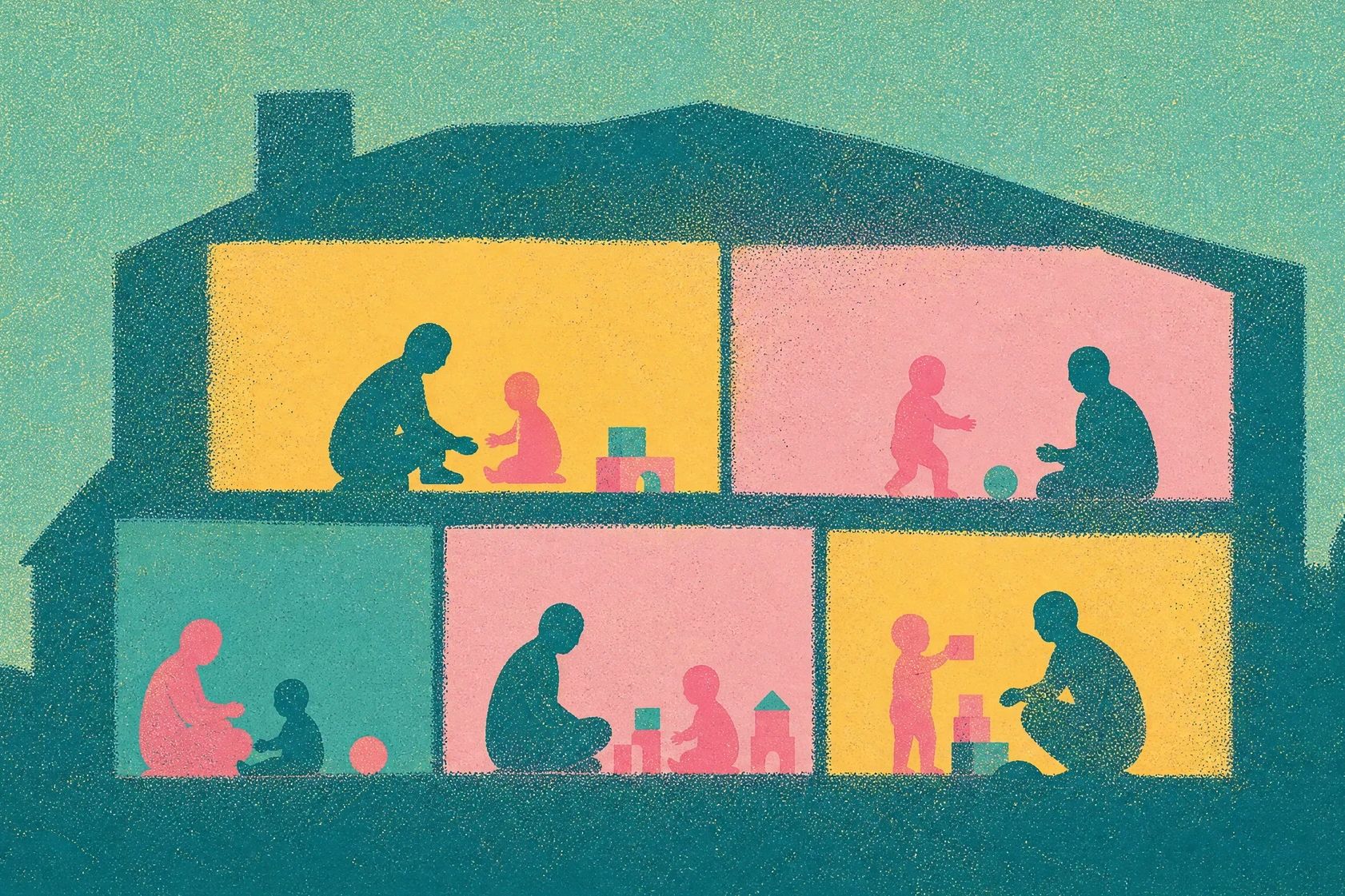
In my own setting we are organised into smaller departments, where staff work in teams. That means that although the setting as a whole is large, the children's everyday lives are shaped by smaller, more manageable communities.
The children have their familiar surroundings, routines and adults around them. They do not have to relate to the whole setting at once, but can be part of a smaller community where there is room to create familiarity and secure relationships.
For me, this is an important point: a large setting does not have to feel large in the children's everyday lives.
It is about how we arrange the space, how we organise the groups, and how we create frameworks that start from the children's needs.
Teamwork creates safety and less vulnerability
One of the great strengths of working in teams is the shared responsibility and the knowledge of the children.
When staff work closely together, more adults gain a deep knowledge of the children's personalities, needs, relationships and everyday lives. That means the children are not necessarily dependent on one particular adult in order to feel a sense of familiarity and safety.
This becomes especially clear when everyday life is disrupted by illness or other absence.
In every daycare setting we have periods when staff are away. Here, well-functioning teamwork can be a great strength. When the children already know several adults, and the staff share a common knowledge of the group, everyday life becomes less fragile.
That does not mean, of course, that the individual adult matters less. Children need close and stable relationships. But it does mean that we can create a stronger web around the child, where a sense of safety does not depend on one member of staff being present.
That is a quality I think deserves more attention in the debate.
Leadership close to practice makes a difference
Another important factor is leadership.
In our setting we have leadership in the individual departments. That makes possible a leadership that is closer to the early years practice, the staff and the challenges that arise in everyday life.
For me, it is crucial that leadership is not only about operations, meetings and administration. Leadership should also help support the early years practice, set a direction and ensure that staff have the best possible conditions for doing their job.
A large setting needs clear organisation and leadership that can create coherence across the whole. But with a leadership structure close to the departments, size can also hold good opportunities for professional development and sparring.
Large settings do not necessarily have worse staffing ratios
When we talk about large daycare settings, staffing ratios often become part of the discussion.
But a large setting does not necessarily have a worse staffing ratio than a small one.
What matters is not only how many children are enrolled in the setting as a whole, but what staff resources are available, how they are distributed, and how everyday life is organised.
A small setting does not automatically mean more adults around each child. In the same way, a large setting does not automatically mean less closeness.
We should of course make demands of staffing ratios and pedagogical quality. But we should also be aware that size and quality are not the same thing.
Size can also offer professional opportunities
There are also opportunities in larger settings that I think we should remember to include in the debate.
A larger organisation can give access to more colleagues, different experiences and the chance of professional sparring across departments and teams.
That can strengthen the sharing of knowledge, inspiration and the development of early years practice.
When the collaboration works, staff can draw on one another's skills and experience. That can help create a stronger professional culture, where we do not stand alone with the challenges we meet in everyday life.
It does not happen by itself. It takes conscious organisation and a culture in which collaboration and a shared professional approach are given priority.
Perhaps we should be discussing quality rather than size?
I do not believe that large settings are the right solution everywhere. And I do not believe that small settings are any less good.
There are both large and small settings with high pedagogical quality.
But I miss a more nuanced debate.
Because when we discuss the size of daycare settings, we should also be asking some other questions:
How are the physical surroundings arranged?
How do we create smaller, safe communities for the children?
Do staff have the chance of well-functioning teamwork?
Is leadership close enough to the early years practice?
How do we ensure stable, meaningful relationships with adults?
Do we have the staff resources needed to create a good everyday life?
These are questions that, in my view, are at least as important as whether the setting has 50, 100 or 200 children.
Because children do not necessarily need the setting to be small. They need safe surroundings, present adults, familiarity, and communities in which they are seen, met and understood.
And that can be done in a large setting.
It is about what we create within the framework
I think we should be careful not to make size the scapegoat for the challenges facing daycare.
There are many important discussions about staffing ratios, working conditions, pedagogical quality and children's well-being. We should take those seriously.
But we should also dare to look at how we organise ourselves, and at the possibilities that lie in different ways of running a daycare setting.
A large setting can be hard to take in if the organisation does not work. But a small setting can also be vulnerable if the conditions and resources are not sufficient.
What matters is whether we succeed in creating an everyday life in which children experience closeness, safety and stable relationships.